The November birthstone is unusual in that it comes as a pair. Topaz is the traditional choice and citrine the later alternative, and both are prized for the same warm palette of honey, sherry and marmalade tones. For anyone interested in jewellery history, the pairing is more than a convenience: these two stones were muddled together by jewellers for the best part of two centuries, and that confusion is written into many of the antique pieces that survive today.
We have written before about topaz on its own. Here we look at November's two stones side by side, with a particular eye on citrine, the quieter half of the partnership.
What is the November birthstone?
Topaz has been linked with November since the early birthstone lists were drawn up in the twentieth century. Citrine was later added as an alternative, largely because good yellow and orange topaz had become scarce and expensive, while citrine offered a similar colour at a gentler price.
The two are entirely different minerals. Topaz is an aluminium silicate and sits at 8 on the Mohs scale of hardness. Citrine is a variety of quartz, the same species as amethyst, and sits at 7. Both are durable enough for everyday wear, although each has its own quirks, which we come to below.
Why citrine and topaz were confused for so long
For much of the nineteenth and early twentieth centuries, "topaz" was used less as a mineral name than as a colour description. Any transparent golden stone might be sold as topaz, and citrine very often was.
The trade invented a string of flattering names to blur the line. You will find old catalogues and descriptions offering "Spanish topaz", "Madeira topaz", "golden topaz" or simply "quartz topaz", all of which usually meant citrine. Genuine topaz, by contrast, was sometimes called "precious topaz" or "imperial topaz" to set it apart.
This matters to collectors because an old box, a family story or a period label calling a stone topaz is not proof that it is. A piece handed down as "grandmother's topaz brooch" is quite often a handsome citrine, and none the worse for it.
How to tell citrine from topaz
A gemmologist can separate the two quickly with a refractometer, but a few observations help even without instruments:
- Weight. Topaz is noticeably denser than quartz, so a topaz of the same size will feel heavier and weigh more on a scale.
- Colour shift. Topaz often shows distinct shades when turned in the light, such as golden in one direction and pinkish in another. Citrine tends to look more uniform.
- Surface wear. Being softer, citrine is more likely to show slightly rounded or scuffed facet edges after a century of wear.
- Cleavage. Topaz has one direction of perfect cleavage, so a hard knock can cause a clean break. Look closely for flat internal fractures.
If you are buying, the simplest test is to ask the dealer how the stone has been identified. A specialist should be able to tell you plainly.
November's stones through the jewellery periods
Georgian
In the Georgian period, fine topaz came principally from Brazil, and the rich sherry and peach shades were highly valued. Stones were usually set in closed-back collets, often with a coloured foil behind them to deepen the colour. Jewellers also discovered that heating certain brownish-yellow topaz could turn it pink, which explains the pale rose stones in some Georgian necklaces and earrings.
Victorian
Citrine came into its own with the Victorian taste for Scottish jewellery, encouraged by Queen Victoria's fondness for the Highlands. Large faceted citrines appear alongside smoky quartz and polished agates in kilt pins, plaid brooches and dirk-style pieces, usually in silver or gold. Our Victorian jewellery and antique brooches are good places to see the craftsmanship of the era.
Art Deco and the 1940s
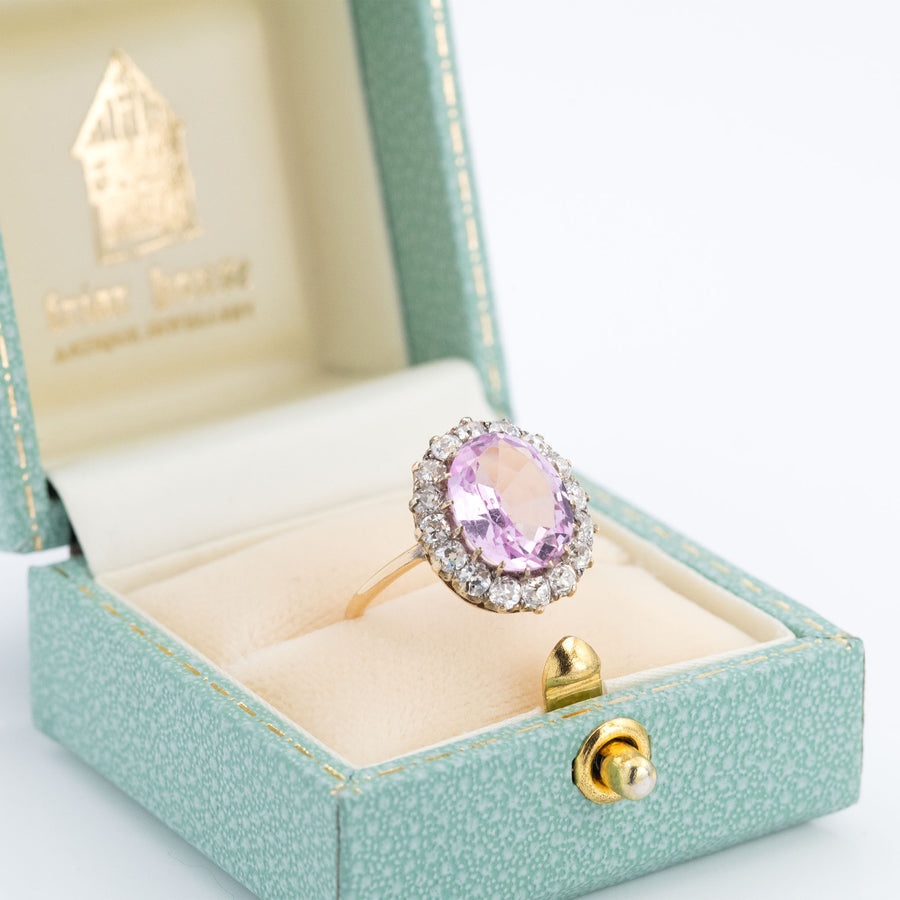
Art Deco designers used golden and pink stones more sparingly than they did sapphires and emeralds, but when they did, the results could be striking. This Art Deco pink topaz cluster ring shows how well the softer topaz shades sit in a period setting.
The real heyday of citrine came in the 1940s. With platinum diverted to wartime use, jewellers turned to rose and yellow gold, and large, generously cut citrines suited the bold, sculptural cocktail rings of the time. A big step-cut or emerald-cut citrine in a scrolling gold mount is one of the signature looks of the period.
Buying an antique or vintage November birthstone piece
A few points are worth bearing in mind before you buy:
- Ask about treatment. Most citrine on the market is heat-treated amethyst, and much topaz has been heated too. This is long established and does not trouble most collectors, but you should know what you are buying.
- Check closed backs. Foiled Georgian settings should be kept dry, as moisture can tarnish the foil and dull the stone permanently.
- Look at the setting as well as the stone. Worn claws on a large cocktail ring are common and easily attended to, but they should be checked. Our guide to choosing an antique dress ring covers this in more detail.
- Mind the light. Some heated stones can fade with prolonged strong sunlight, so store pieces away from a sunny windowsill.
For cleaning, warm soapy water and a soft brush are enough for most citrine and topaz jewellery in open settings. Avoid ultrasonic cleaners with topaz because of its cleavage, and keep foiled pieces away from water altogether.
Finding your own piece
Whether you favour the rosy glow of topaz or the sunny warmth of citrine, November's stones reward a patient search through the periods. Browse our antique gemstone rings and dress and cocktail rings, or keep an eye on our new acquisitions. For the full calendar of stones, our complete birthstone guide has every month.