
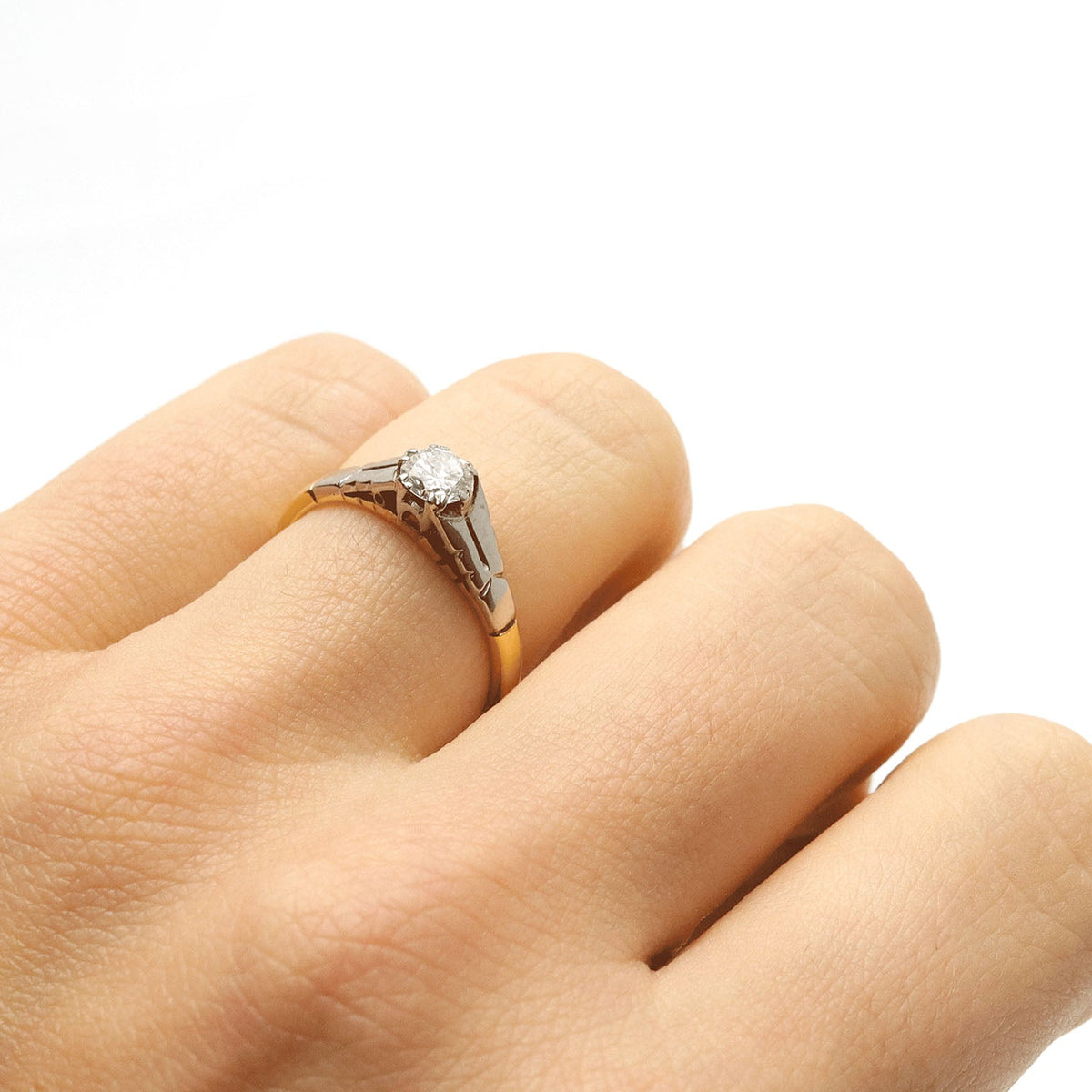
Choosing an engagement ring is one of the most significant purchases you will ever make. In my experience, the couples who are happiest with their choice are those who took the time to understand what they were looking at before they bought. This guide is intended to give you exactly that foundation.
Why an Antique Diamond Engagement Ring?
Before we discuss the details of choosing a ring, it is worth reflecting on why an antique diamond engagement ring might be the right choice in the first place. Every antique ring is genuinely unique — no two are identical, because each was made by hand before the era of machine production. The diamonds in antique rings were cut by craftsmen rather than machines, giving them a character quite different from modern brilliant cuts: warmer, deeper, with larger individual flashes of light rather than the uniform scintillation you find in contemporary stones.
There is also an ethical dimension. An antique diamond requires no new mining — it has already been in existence for well over a century. For many couples today, that matters enormously. I find it one of the most compelling reasons to choose antique, alongside the simple truth that the craftsmanship of the Victorian, Edwardian, and Art Deco periods cannot be replicated today at any price.
Understanding Antique Diamond Cuts
The most important thing to understand when buying an antique diamond ring is that the diamonds themselves are fundamentally different from modern stones, and the formal GIA grading system was not designed for them. The three cuts you will encounter most often are:
The old mine cut — the characteristic diamond of the Georgian and Victorian periods. It has an oval to cushion-shaped outline, a high crown, a small table, and a large flat base called a culet. Old mine cut diamonds have a distinctive warmth and depth that many people find more romantic than modern brilliants.
The old European cut — the dominant cut of the Edwardian period and early Art Deco. Fully circular, with a high crown and small table, it is the direct precursor of the modern brilliant but with a quite different character. Old European cuts show depth and warmth, particularly beautiful in low and candlelight.
The transitional cut — as its name suggests, this bridges the old European and modern brilliant cuts and appears most often in early Art Deco rings from the 1920s.
When I describe a diamond in one of our listings, I focus on colour character and clarity honestly rather than applying GIA grades, which are not meaningfully applicable to these hand-cut stones.
Choosing the Right Period
The period of a ring shapes its entire character, and understanding the differences will help you find what suits you.
Victorian rings (1837–1901) are romantic and rich in symbolism. Yellow gold settings with old mine cut diamonds in cluster or solitaire arrangements are characteristic. Many carry meaningful motifs — serpents for eternal love, forget-me-nots for remembrance.
Edwardian rings (1901–1915) are among the most delicate ever made. The adoption of platinum allowed jewellers to create lacy, almost transparent settings quite impossible in gold. If you love fine detail and lightness, Edwardian is likely your period. Our antique diamond engagement ring collection includes exceptional examples from this era.
Art Deco rings (1920–1939) are bold, geometric, and precise. Platinum dominates, and the construction of these rings is extraordinary — fine milgrain borders, openwork gallery panels, and calibré-cut accent stones fitted precisely into architectural settings. For those drawn to modernity within history, Art Deco is an exceptional choice. You can browse our dedicated Art Deco engagement ring collection for the full range.
The Practical Considerations
Once you have found a ring you love, there are a few practical matters to address.
Ring size. Most antique rings can be resized by one to two sizes in either direction by a skilled jeweller. Full eternity rings — set with stones all the way around the band — cannot be resized conventionally, so accuracy matters more with these. I am always happy to advise on sizing before purchase.
Wearability. Many antique rings are perfectly robust for everyday wear, particularly those in 18ct gold or platinum with secure claw settings. I always note any wearability considerations in individual listings, and will highlight pieces that benefit from more occasional use.
Valuation. Every ring purchased from Friar House comes with a full insurance valuation certificate prepared personally by me, documenting the ring for insurance purposes and confirming its authenticity and current replacement value.
A Final Word
In over thirty years of working with antique jewellery, the most important advice I can give is this: buy a ring you love the look of, not one that ticks boxes on paper. The couples who are happiest with their antique ring are those who fell in love with a specific piece rather than a specification. If you would like to discuss what we have available, or would like additional photographs or a video of any ring in our collection, please do get in touch — I am always delighted to help.
Browse our antique diamond engagement rings
Every piece personally selected and authenticated by Victoria Dahms. All purchases include a full insurance valuation certificate and free fully insured worldwide shipping.